Bodies in a state of eruption: the performance and metamorphosis of Malu Avelar
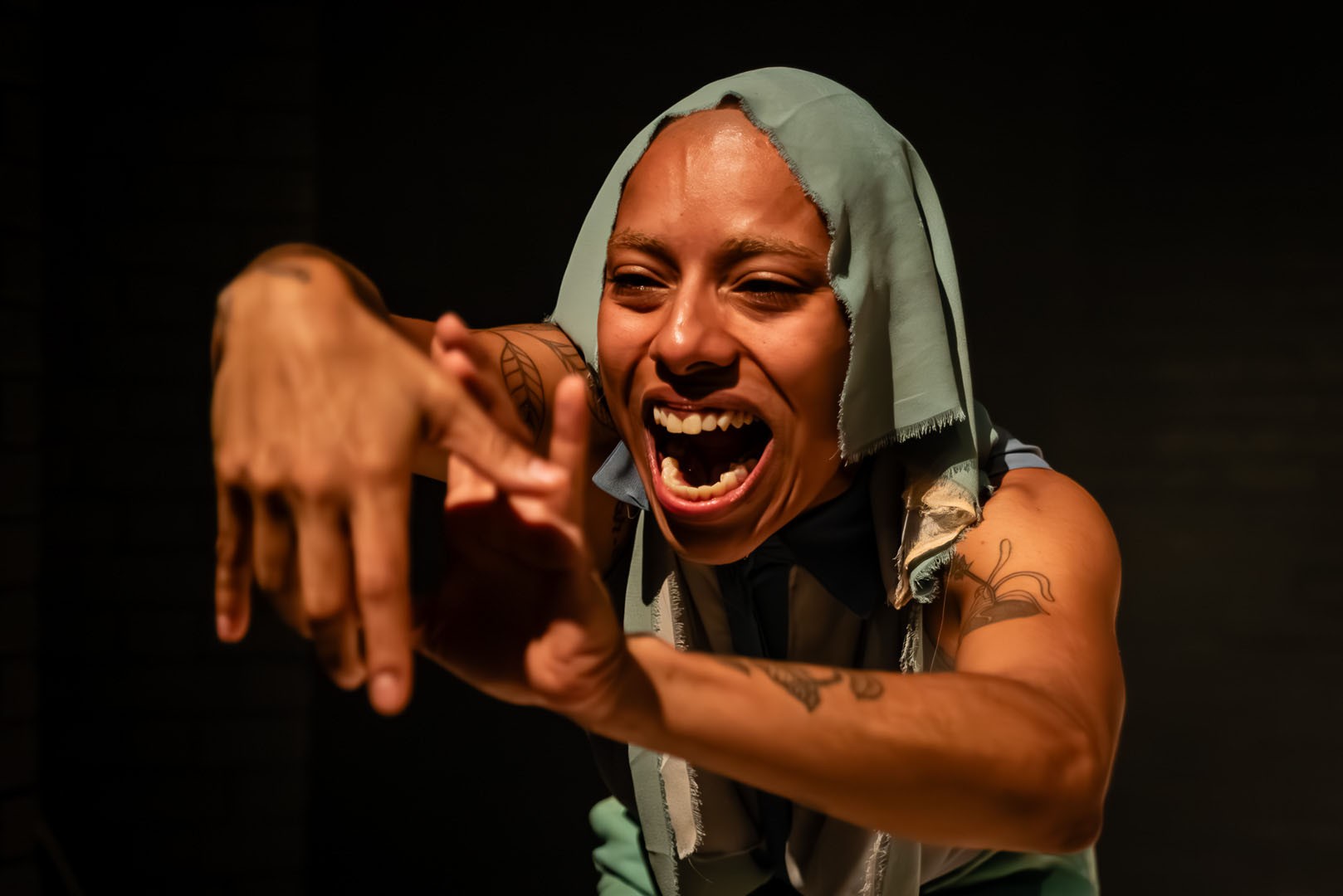
Malu Avelar, 1300° qual a saúde de um vulcão (1300° — what is the health of a volcano?). Photo: Sergio Fernandes
In her performance, Malu Avelar, an artist from the Brazilian state of Minas Gerais, blurs the boundaries between the body and matter. Voices emerge like earthly forces, summoning presence, fear, and desire. This text fabulates on Malu’s work to reflect on health, monstrosity, and superhuman ways of existing.
When I think about Malu Avelar's performance 1300° — what is the health of a volcano?, I feel a need to be radically present, as if I could get back something that is constantly being taken from us. This invitation stems from the understanding that we are called to make ourselves available beyond mere observation.
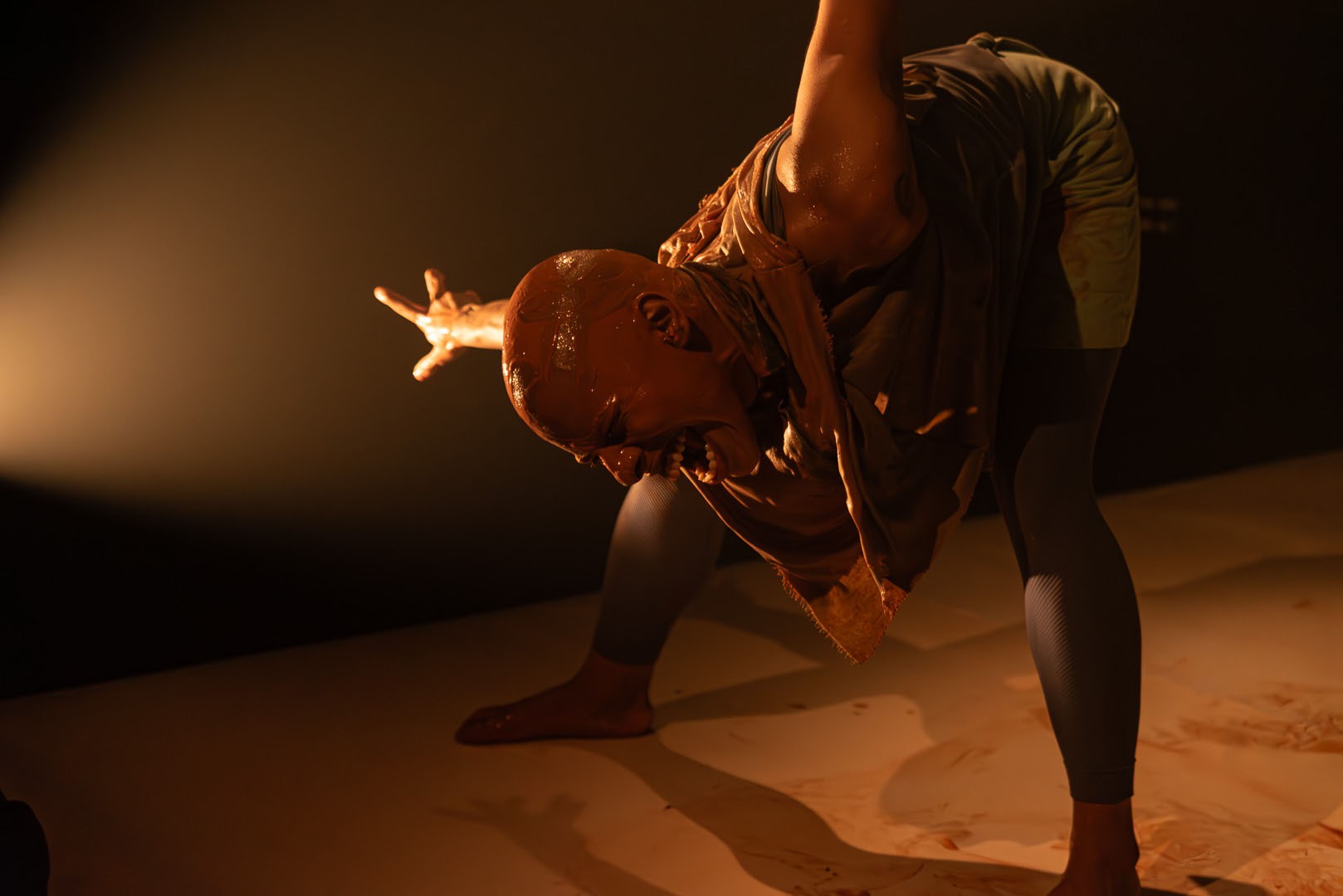
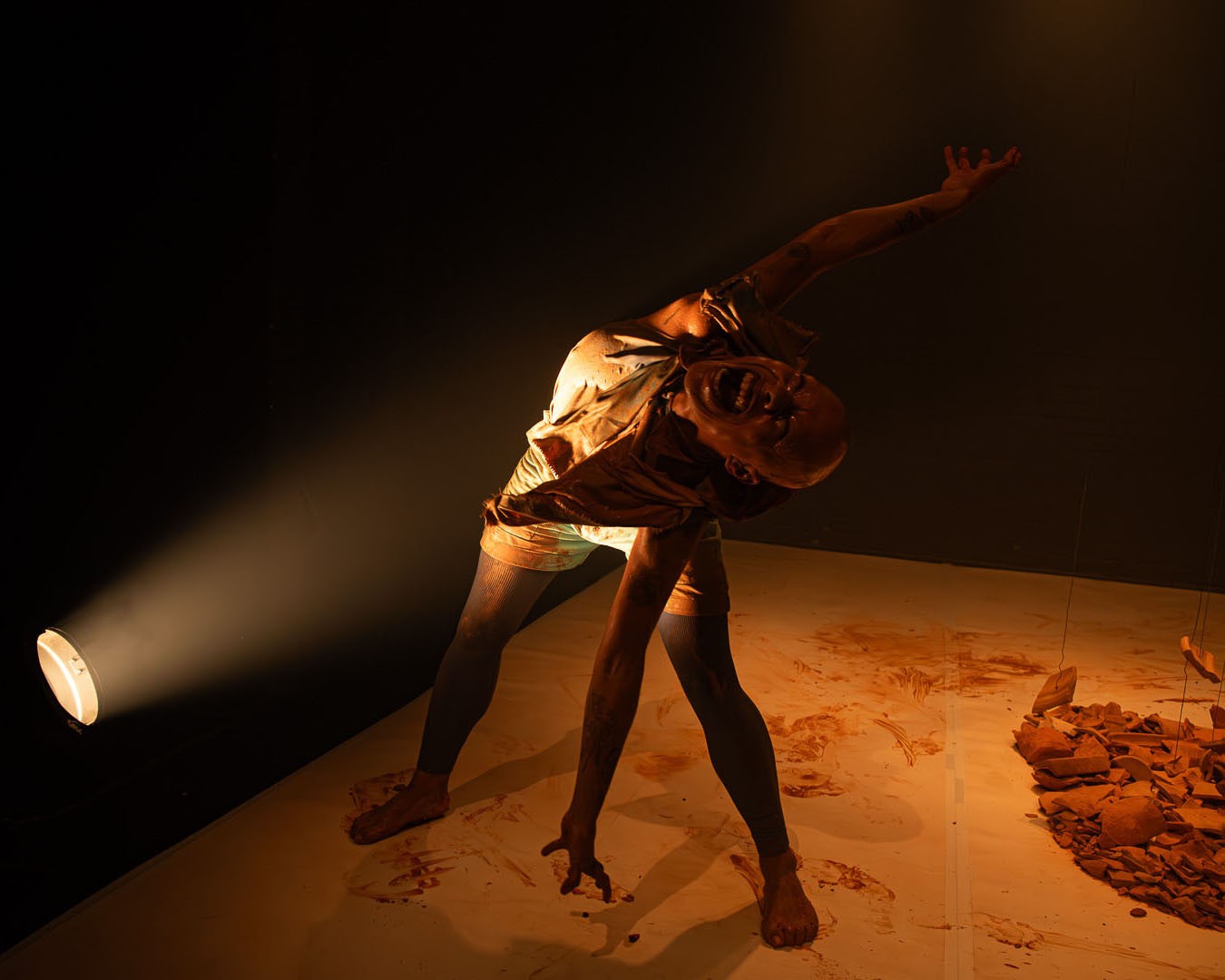
Avelar convenes a magnetic encounter upon entering the small linoleum-floored room, with a mobile made of ceramic shards hanging in the center. From this encounter, she develops a dance that unfolds in bodily and vocal metamorphoses, inspired by the research of Rodrigo Reis in “Intensive Glossolalia: How to create a voice for the body without organs (or ecology of practices for a schizovocality)”. Her body transitions through various states—water, clay, fire, air, and stone—each associated with a pulmonic consonant. In articulating these intense sounds and movements, she brings forth lives beyond the human.
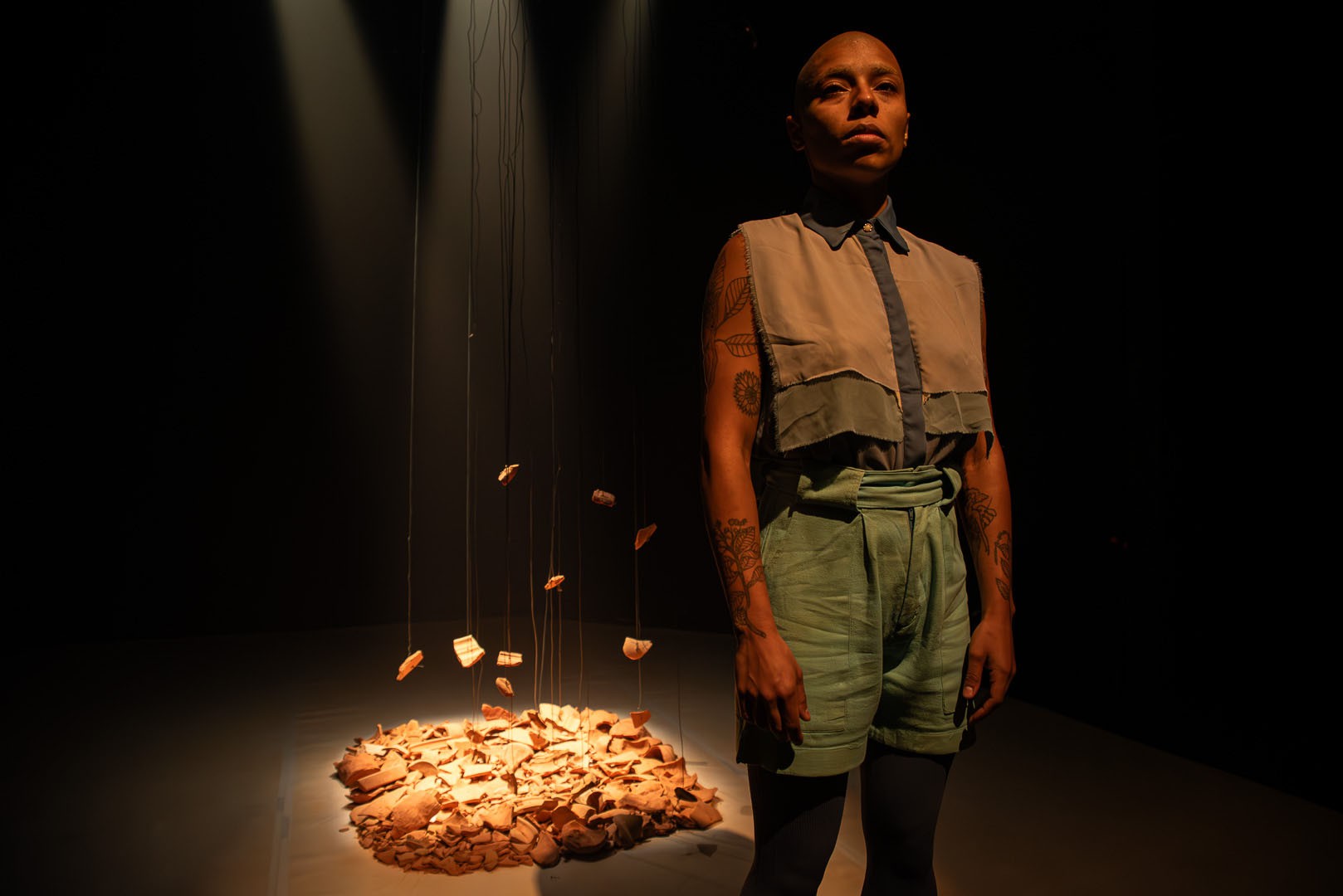
Malu Avelar, 1300° qual a saúde de um vulcão (1300° — what is the health of a volcano?). Photo: Sergio Fernandes
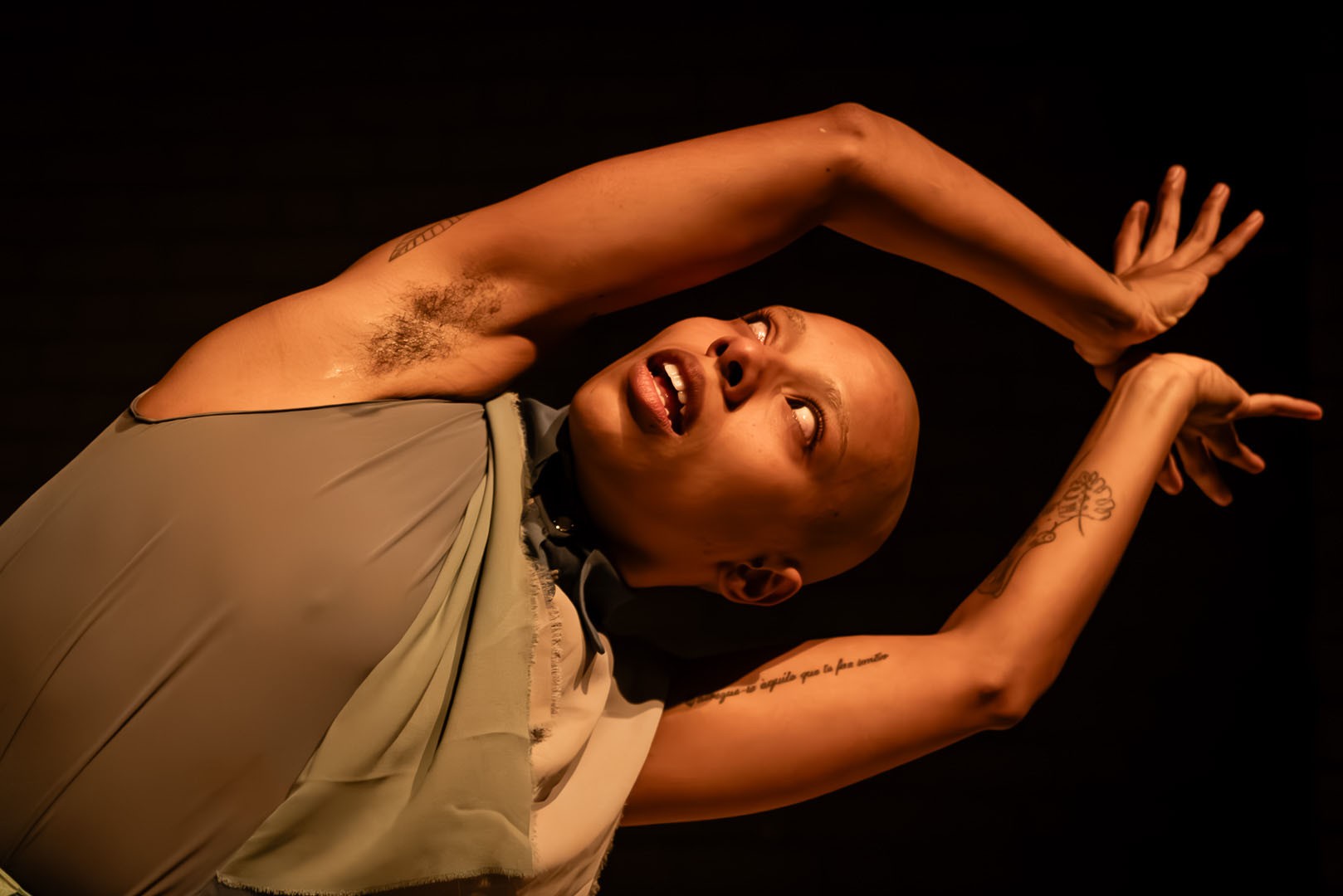
Malu Avelar, 1300° qual a saúde de um vulcão (1300° — what is the health of a volcano?). Photo: Sergio Fernandes
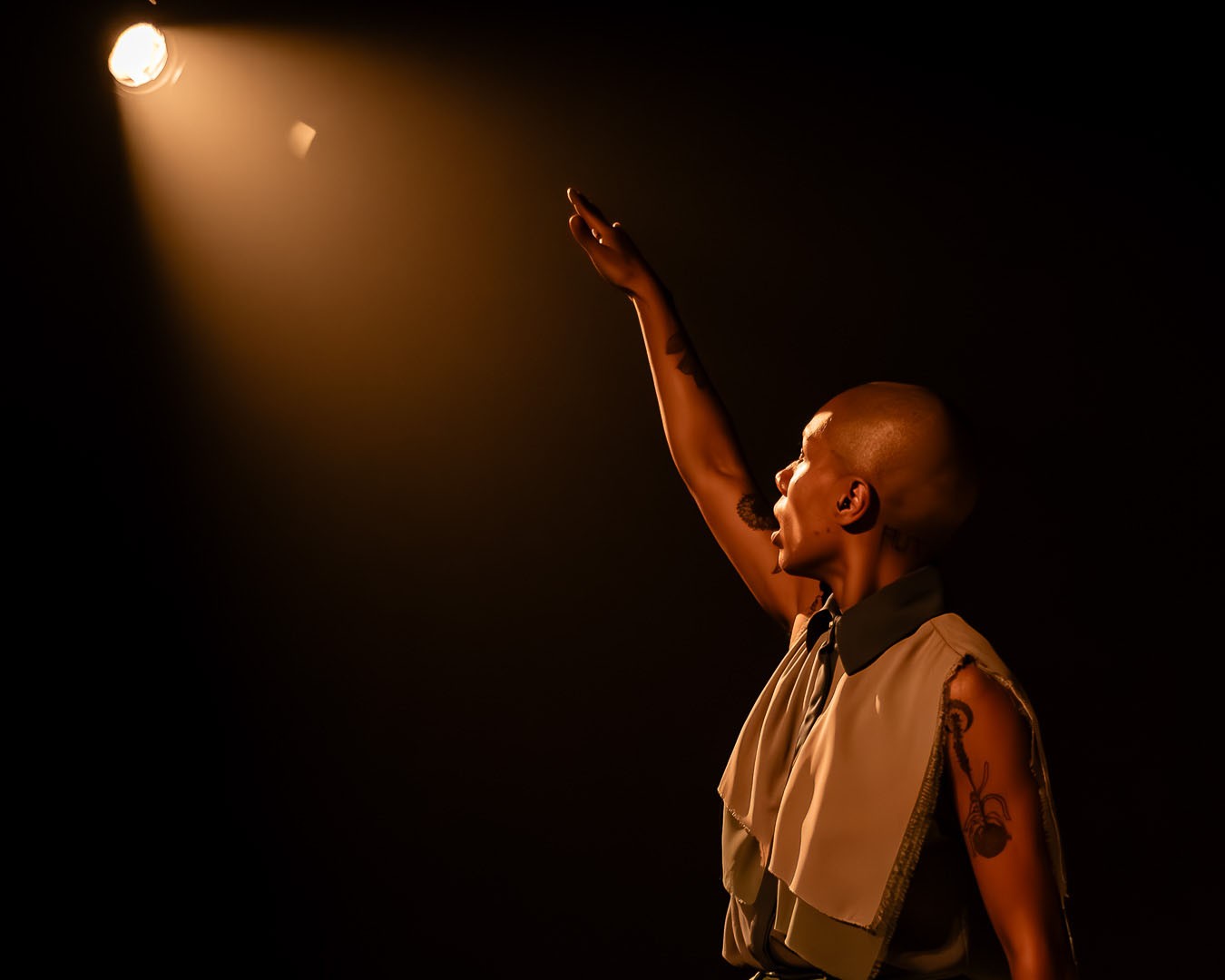
Dissolved in water, she flows in continuous ripples until settling on the clay, traversing slow and viscous textures. Avelar bursts into urgent movements that make her body tremble, and her face transfigure as it reveals itself to be incandescent magma. The air, in its expansive lightness, restores and oxygenates until she reaches the stone, where density prevails and slowness safeguards the ancient. Stone is always difficult, because its mineral power inhabits a temporality that demands patience. The vocalization that traverses these states is astonishing, as is the lava’s blue light, an allusion to Kawah Ijen volcano in Indonesia.
As an audience, we recognize ourselves as part of, almost complicit in, this telluric choreography that, in dialogue with the lighting and soundtrack, expands our perceptions of what we decode as voice, corporeality, and movement.
By moving her body to disrupt its form, Malu opens up a magnetic field. It’s a beauty that is not revealed immediately, but that insinuates itself through the tension and fear of what we’ve learned to call "monstrous". Those watching are seduced by these immense and "terrifying" presences because we’ve been taught to perceive them as threatening—volcanoes, whales, the sea, among others—though we also wish to approach them, either by recognizing some kinship or by the impulse to dominate them.
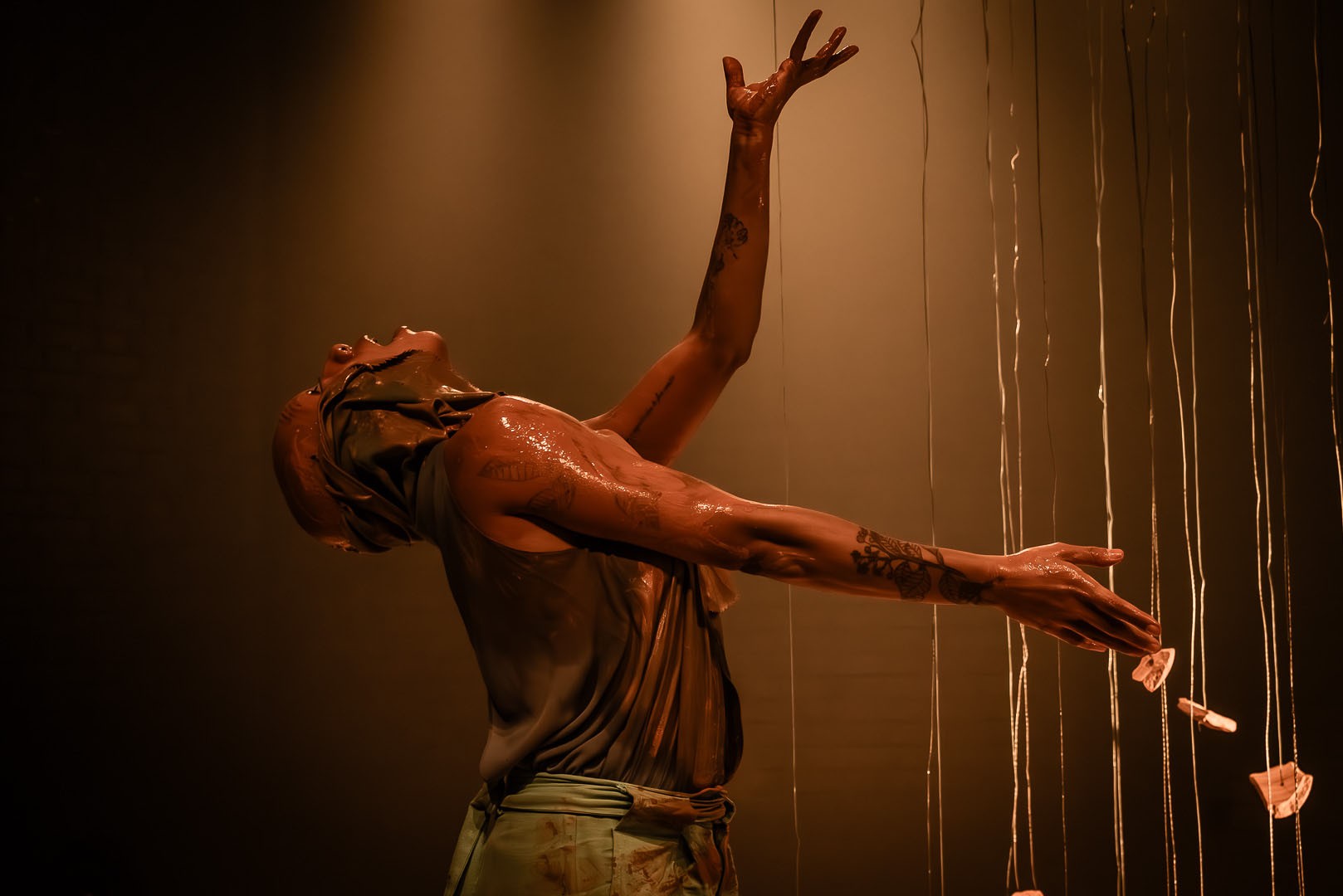
Malu Avelar, 1300° qual a saúde de um vulcão (1300° — what is the health of a volcano?). Photo: Sergio Fernandes
Malu Avelar, 1300° qual a saúde de um vulcão (1300° — what is the health of a volcano?). Photo: Sergio Fernandes
These metamorphic processes lead me to [re]remember the trilogy Xenogenesis, by Octavia Butler (1947–2006), especially Imago. Butler narrates the experience of a group of humans rescued by the Oankali* after the end of the world, exploring the dynamics of coexistence and imagining a networked future. For the Oankali, survival requires consent to genetic fusion: by offering technology and cures to repopulate the planet, they incorporate and alter the human species, based on the premise that it has self-destructive tendencies.
What interests me when comparing this work of fiction to what Avelar creates is that the beings of Imago are ooloi, entities capable of metamorphosing into multiple existences, establishing instability and affirming life as something in flux. As I bring up in Only water sustains our weight, “the monster inhabits the border of normativity [human], because monstrous existence is expansive, excessive and does not fit into the regularity imposed by those who mirror the notions of what is 'normal'”. These other ways of being in the world in Butler's story lay bare the tensions of between human and monster, just as Avelar does, but both go further: they explore the deviation from this binary.
Anyone who thinks Malu claims the human or monstrous side of this world is mistaken. On the contrary, her work offers us the chance to radicalize perceptions that imprison us: monsters or, for those already recognized, humans, and to question the expectation that the promise of "becoming human" will be fulfilled for people like us: racialized, gender dissident, and so many others. The immediate exercise would be to ask: what would happen if we gave up on becoming? What kind of collapse would that produce? Would our health suffer as a result of this practice?
Malu Avelar, 1300° qual a saúde de um vulcão (1300° — what is the health of a volcano?). Photo: Sergio Fernandes
Malu Avelar, 1300° qual a saúde de um vulcão (1300° — what is the health of a volcano?). Photo: Sergio Fernandes
By revisiting the roar, we can understand it as an announcement of what is to come for the lives that emerge from the destruction of that which prevents them from sustaining health in this world. At that moment, when all spirits open their mouths together with the earth, those relegated to the margins of humanity regain the strength of their rage, thus creating a space that imagines body and dream as signs of a movement of going and coming that, upon returning, is no longer the same.
Therefore, in addition to exploring radical forms of existence that inhabit the realm of the unspoken, it proposes an ethics of creation-with, recognizing matter as a shared relationship, not a receptacle. Avelar is willing to meander from the depths of the earth, summoning us to sustain the state of presence and to organize possibilities of existence and kinship that engender ecosystems and interactions, making use of sensitivity to reconfigure other forms of cognition.
1300° — what is the health of a volcano? was atTeatro Sesc Tijuca, Rio de Janeiro, Brazil from May 29 to June 1, 2025.
* Oankali are alien beings that possess three sexes: male, female, and ooloi (non-binary or neutral).
About the author
Camila Fontenele
Camila Fontenele is a researcher, curator, freelance photographer, and visual artist. She holds a master’s degree in Studies of the Human Condition from UFSCar, a graduate diploma in Cinema, Television and Video (Belas Artes/SP) and a bachelor’s in Communications (UNISO). She researches the relationships between body, speculative fabulation and interspecies, unfolding frictions between human and monster, and in the broadening of imaginations to other forms of existence.
Opinion
Sugar Island: A Film that Lays Bare the Colonial Legacies between Haiti and the Dominican Republic
Not for Sale: How Black and Indigenous artists are rewriting the rules of the art market
What’s Behind Decolonial Movements in Brazil?
Opinion
Sugar Island: A Film that Lays Bare the Colonial Legacies between Haiti and the Dominican Republic
Not for Sale: How Black and Indigenous artists are rewriting the rules of the art market