ficciones patógena
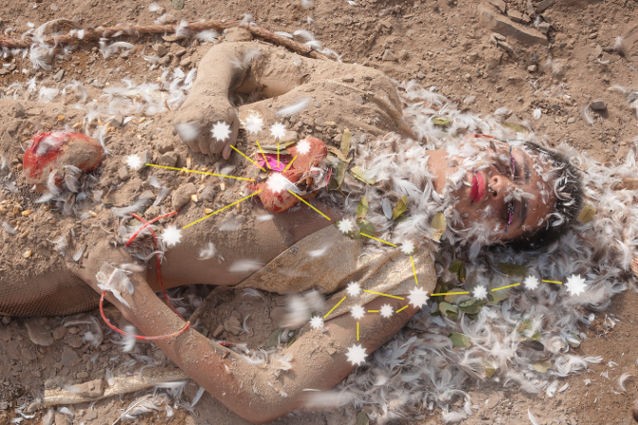
ficciones patógena
{{B:ficciones patógena }}is a group show of nineteen artists exploring how ficciones patógenas (pathogenic fictions) have been perpetuated and embodied, occluding local, non-Western, and Indigenous ways of being and knowing. The exhibition is organized by Georgie Sanchez and LLMA Head Curator and Director of Exhibitions and Collections, Stamatina Gregory.
“Possessed.” “Deviant.” “Sick.” Historically, colonial regimes attempted, gained, and maintained control over cuir/kuir/queer, trans, Black, and Indigenous people by pathologizing them along with their relationships—to the land, to the nonhuman, to one another. The rich sexual and gender diversity of the many cultures of Abya Yala (Kuna linguistic term for the entirety of the Americas ) was unintelligible to Western knowledge frameworks.
Sanchez speaks to the importance of organizing the exhibition:
“How have mechanisms of deceit, theft, warfare, and disease become institutionalized over time in this killing machine we call ‘America’? The artists in ficciones patógenas engage/refuse these grammars of dispossession as well as our current pre-invented binary existence. Their activism and creative practices reverberate Frantz Fanon’s unruly words that ‘one cannot divorce the combat for culture from the people’s struggle for liberation.’”
To justify acts of violent dispossession and extraction, they characterized specific ways of existing as unnatural. These narratives have wound through legal, religious, cultural, political, and ideological structures in Abya Yala since 1492, and—as ficciones patógenas/pathogenic fictions)—they shape our understandings of bodies, land, culture, and power today. The exhibition’s title is taken from the 2018 book of the same name by Guaxu trans writer, activist, and participating artist Duen Neka’hen Sacchi which traces their own medical history through Western regimes of bodily conformity. The wounding and suturing of Neka’hen’s body (and other nonconforming bodies), based on false notions of order and reproduction, echoes the violent reshaping of the “Indies,” which inextricably bound biology to nationhood. Through hybrid practices that draw from Indigenous, colonial, and contemporary images and strategies, the artists in the exhibition propose ways in which land and bodies exist as sites of resistance and transformation. Many of the works in ficciones patógena will enter the permanent collection of the Leslie-Lohman Museum of Art. Including works by Carlos Arias, Felipe Baeza, Seba Calfuqueo, Javier Cardona Otero, Colectivo Ayllu (álex aguirre sánchez, iki yos piña narváez, kimy/leticia rojas miranda, lucrecia masson córdoba, francisco godoy vega), Mandorilyn Crawford, Gian Cruz, Frau Diamanda, Venuca Evanán, Camilo Godoy, Carlos Martiel, Lulu V. Molinares, Lizette Nin, Rio Paraná (Duen Neka’hen Sacchi, Mag de Santo), Duen Neka’hen Sacchi, Javi Vargas Sotomayor, Lucía Egaña Rojas and Ju Salgueiro, Luis Fernando Zapata. Leslie-Lohman Museum of Art Located at 26 Wooster Street in the SoHo neighborhood of New York City. Open Wednesday, 12-5pm, Thursday - Sunday, 12-6 pm.
View more from
Nigerian Modernism – Group Show
Oct 8, 2025–May 10, 2026
Roméo Mivekannin: Correspondances
Oct 2, 2025–Mar 21, 2026
The Writing’s on the Wall (TWTW)
Sep 13, 2025–Mar 14, 2026
Seydou Keïta: A Tactile Lens
Oct 10, 2025–Mar 8, 2026
ECHO DELAY REVERB: American Art and Francophone Thought – Group Show
Oct 22, 2025–Feb 15, 2026
Tesfaye Urgessa: Roots of Resilience
Sep 20, 2025–Feb 15, 2026