the sky with root-eyed
the sky with root-eyed
Through her practice, which oscillates between art and pedagogy, Minia Biabiany explores the lands, languages, and identities of the Caribbean, creating spaces of resistance and healing in response to the impacts of colonialism.
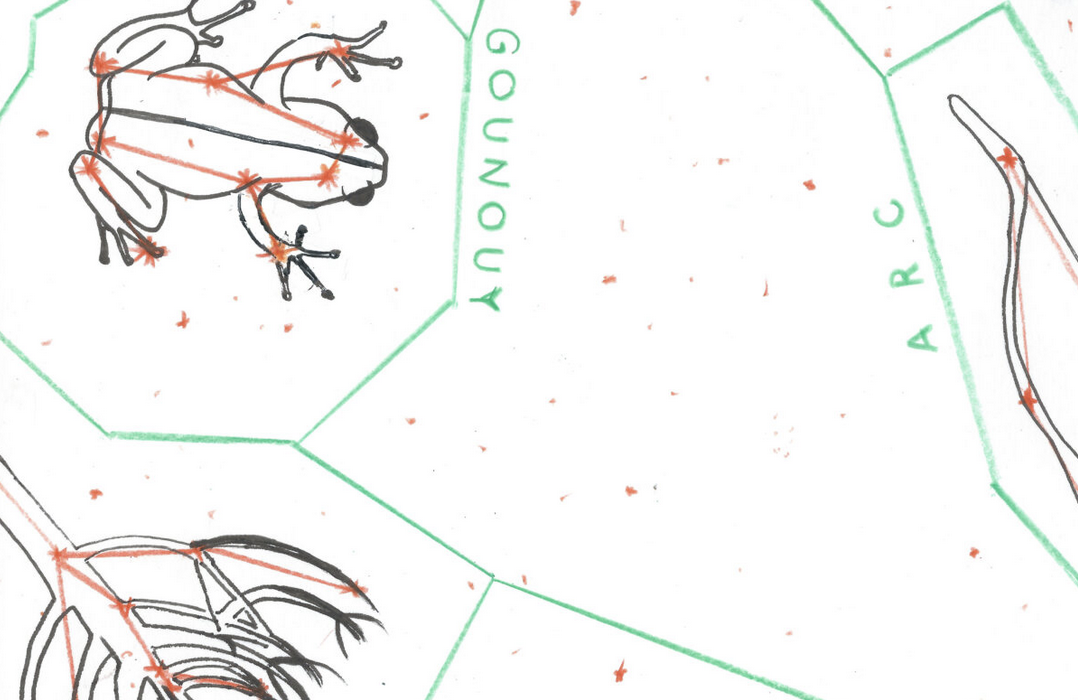
For {{I:the sky with rooted-eyes}}, Biabiany creates a new constellation — the frog — traced from the night sky of Guadeloupe at the time of the exhibition. Each star of the constellation is embodied in a ceramic sculpture, and together they outline the image of this nocturnal amphibian, whose song signals the shift from day to night. The sculptures are reflected in water-filled calabashes placed on the ground. This creates a dynamic interplay, a mirroring between water, earth, and sky, between the cosmic and the everyday.
Inspired by the Blue Crab constellation—one of the few traditional constellations of the Kalina people that has endured through the ages to reach us, and whose rise above the horizon signals the solar cycle —Biabiany reimagines celestial cycles from her own perspective. Her interpretation provides us with new ways to position and orient human bodies in space.
The works of the installation are interconnected by ropes braided from banana fibers, interspersed with organic sculptures of charred wood, each representing distinctive elements of Guadeloupe’s natural environment. Braiding, which is central to Biabiany’s practice, becomes both a storytelling tool and a quest for fresh metaphors to express her relationship to the land, and an act of resistance against the erasure of language. Rooted in orality and deliberate slowness, it serves as a thread for reconsidering how we structure narrative and language.
The banana flower—a recurring motif in the installation—embodies the duality of Guadeloupe’s history. It simultaneously symbolizes the harmful health effects of chlordecone1 poisoning and the medicinal properties of the plant itself. Through this contrast, Biabiany explores the land’s ability to reclaim its own memory and heal the wounds of colonialism, creating a space where memory, poetry, and politics converge.
[1] This toxic pesticide, used from 1972 to 1993 on banana plantations in Martinique and Guadeloupe, contaminated the soils and waters of these territories, leaving a lasting impact on both the population’s health and the local ecosystem.
Galerie Imane Farès
41, rue Mazarine
75006 Paris – France
View more from
Nigerian Modernism – Group Show
Oct 8, 2025–May 10, 2026
Roméo Mivekannin: Correspondances
Oct 2, 2025–Mar 21, 2026
The Writing’s on the Wall (TWTW)
Sep 13, 2025–Mar 14, 2026
Seydou Keïta: A Tactile Lens
Oct 10, 2025–Mar 8, 2026
ECHO DELAY REVERB: American Art and Francophone Thought – Group Show
Oct 22, 2025–Feb 15, 2026
Tesfaye Urgessa: Roots of Resilience
Sep 20, 2025–Feb 15, 2026